
 English
The global outdoor landscaping and agricultural vegetation management industry has achieved rapid growth in 2026, with commercial greening, orchard maintenance, hillside governance and rural land renovation becoming core growth driving forces. According to the latest 2026 remote lawn mower industry data, tracked lawn mower products occupy 62.1% of the global professional terrain mowing market share, far exceeding wheeled equipment in the commercial engineering field. The market is projected to maintain a 9.01% annual growth rate from 2025 to 2032, as more contractors and farm owners abandon traditional manual mowing and unstable wheeled mowers for complex terrain solutions.
Industry research shows that more than 73% of terrain mowing failures in 2025 were caused by insufficient traction, ground sinking and slope slippage. As global terrain renovation projects expand, the industry trend is clearly shifting toward specialized all‑terrain intelligent mowing equipment. Remote control tracked lawn mower has become the mainstream upgrade direction for high‑standard greening projects, because it solves the long‑standing pain points of low efficiency, high risk and high loss of traditional mowing equipment on steep slopes, muddy land and rugged wasteland. In addition, with the improvement of global environmental protection and intelligent operation standards, low‑noise, high‑stability and low‑damage tracked mowers are gradually replacing outdated fuel equipment, forming a stable incremental market demand.
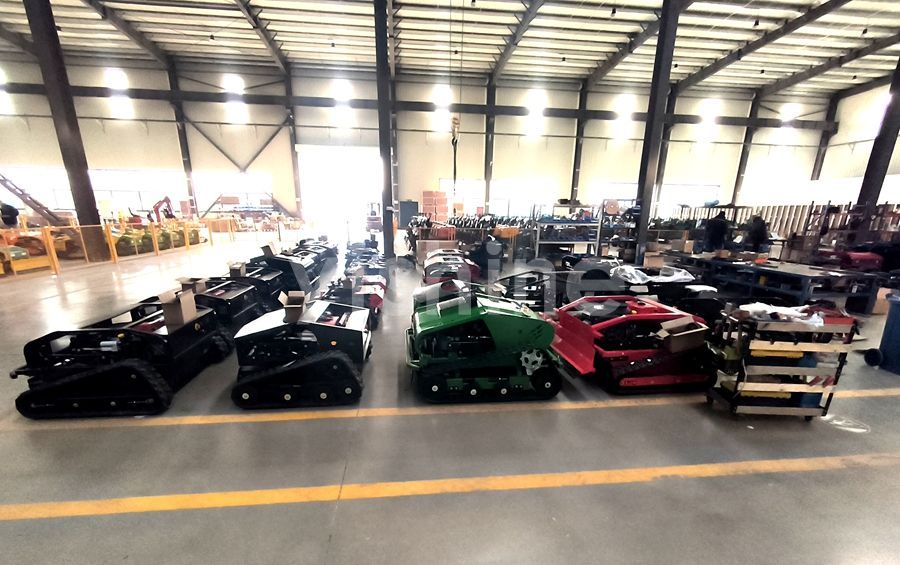
Professional R&D Test Data & Technical Analysis
To verify the actual performance of tracked lawn mower in extreme working environments, our R&D team completed a 42‑day full‑scenario field test in 2026, covering 10° to 35° steep slopes, post‑rain muddy soil, stony rugged land and overgrown orchard ground. The test unified power configuration, working time and environmental conditions, and recorded traction stability, ground damage degree, effective mowing rate and component wear data in real time.
Jack Lee, senior machinery R&D supervisor, released authoritative test conclusions: “The core competitiveness of tracked lawn mower lies in uniform ground pressure distribution and continuous contact traction. Many users underestimate terrain complexity and choose wheeled equipment, resulting in 30% to 40% invalid working hours every month. The optimized chassis structure of our remote control tracked mower greatly improves terrain tolerance, which is the key reason why it adapts to almost all non‑extreme complex terrains.”
Test quantified data shows that the average ground pressure of tracked lawn mower is only 0.04 to 0.06 MPa, 67% lower than traditional wheeled mowers. On 15° to 25° steep slopes, the slip rate is controlled within 4% to 7%, while ordinary wheeled mowers have a slip rate of more than 21% under the same conditions. In continuous muddy ground operation, the tracked structure reduces sinking failure rate by 92%, and the effective mowing efficiency on uneven terrain is 33% higher than wheeled models. After 42 days of high‑intensity cycle test, the overall failure rate of the tracked chassis is only 2.3%, showing extremely stable mechanical reliability.
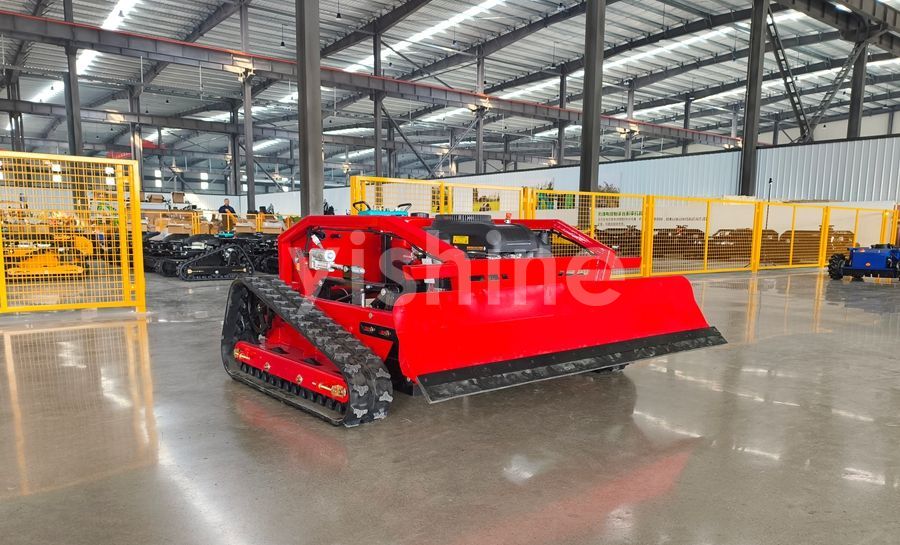
Core Advantages & Technical Characteristics of Tracked Lawn Mower
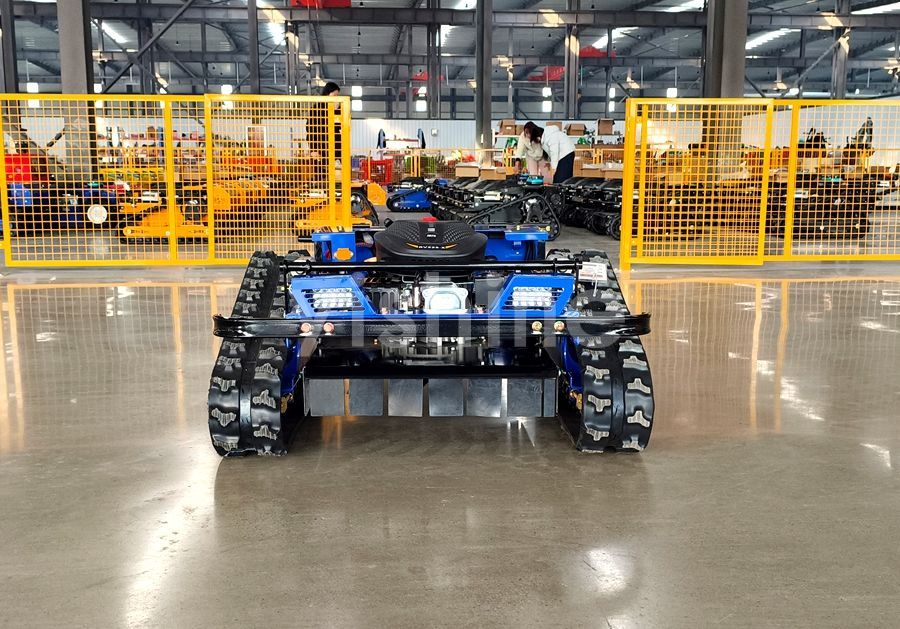
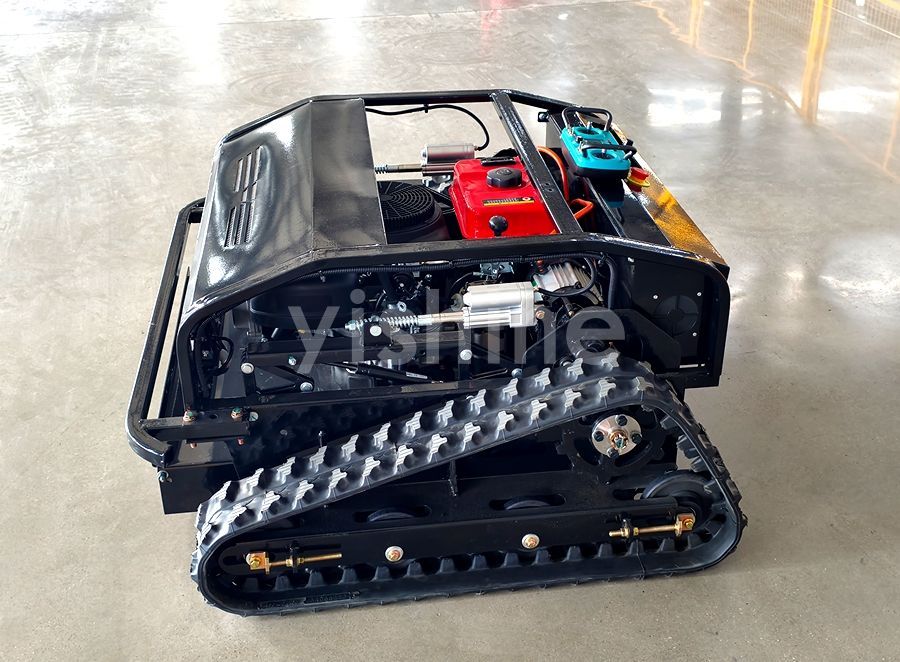
Different from wheeled mowers that rely on local tire contact, tracked lawn mower adopts full‑surround rubber track fit design, which can evenly disperse the whole machine weight and form stable holding force on loose, humid and undulating ground. This structural advantage makes tracked lawn mower for steep slopes the most reliable equipment for hillside greening and orchard weeding.
The remote control tracked mower cancels manual push operation and supports long‑distance intelligent control. Operators can complete mowing work in a safe area, completely avoiding falling risks and dust pollution caused by steep slope manual operation. The equipment supports adjustable cutting height, adaptive weed density cutting and in‑situ zero‑radius turning, which can flexibly pass through narrow orchard intervals and dense shrub areas that large wheeled equipment cannot enter.
In terms of ground protection, the flexible track structure will not cause rigid extrusion on lawn roots and surface soil. Compared with wheeled mowers that easily roll out ruts and damage vegetation, tracked mowers reduce soil hardening rate by 58%, which can well protect the ecological environment of pastoral lawns and scenic green belts. In terms of power adaptability, the upgraded power system maintains stable power output under low‑speed and high‑torque conditions, which is suitable for thick weeds, wild shrubs and long‑term overgrown complex vegetation environments.
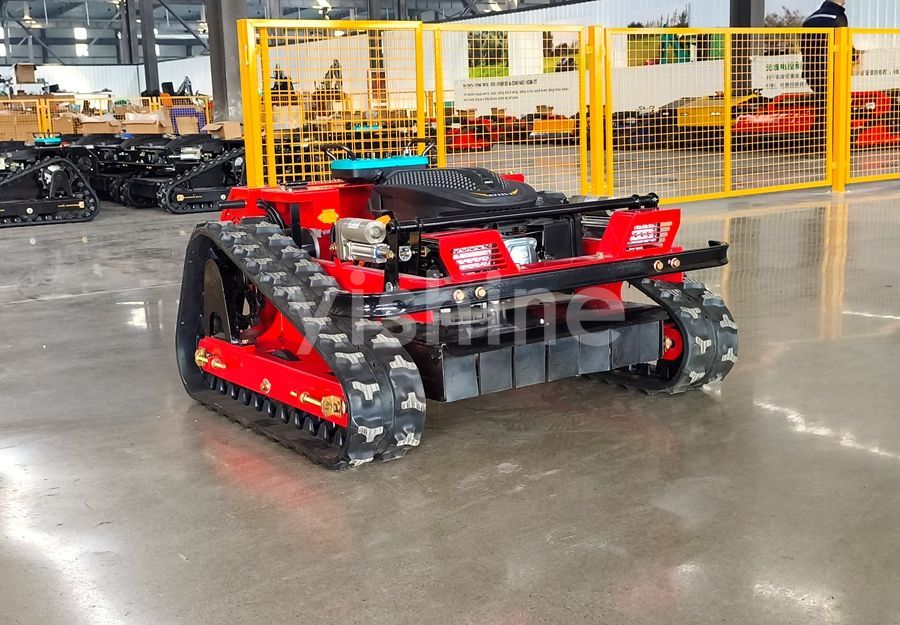
Applicable Working Scenarios
Tracked lawn mower covers almost all complex terrain scenarios that traditional mowers cannot adapt to. It is widely used for mountain orchard weeding, hillside pasture trimming, steep slope landscape greening, post‑disaster wasteland renovation, wet riverbank vegetation management and stony mountain land cleaning.
For commercial engineering contractors, remote control tracked mower can greatly reduce labor input and safety accident risks, and improve project completion efficiency. For farm owners with large‑area sloped orchards and pastures, the equipment can realize unattended regular maintenance, reduce long‑term manual management costs, and maintain stable mowing quality throughout the year. For scenic spots and ecological protection areas that require high environmental protection, low ground damage and low noise characteristics also make tracked mowers the preferred green maintenance equipment.
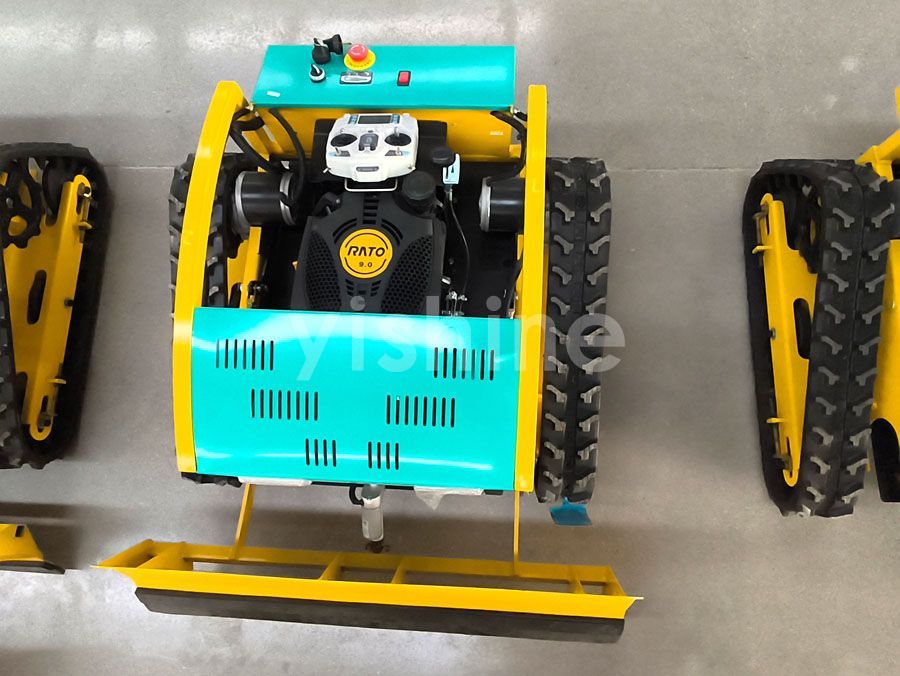
Maintenance & Full‑Cycle Cost Performance
Although the manufacturing precision of tracked lawn mower is higher than that of wheeled equipment, its long‑term comprehensive cost performance is more prominent in complex terrain. The service life of standard rubber tracks reaches 900 to 1100 working hours, and standardized daily inspection can increase the track service life by 30%. The main vulnerable parts are concentrated in tension wheels and guide wheels, with low replacement difficulty and transparent accessory prices.
Test data shows that under long‑term complex terrain operation, the comprehensive failure rate of tracked mowers is 41% lower than that of wheeled mowers, and the service life of the whole machine is 1.8 times that of ordinary wheeled equipment. Although the single maintenance cost is slightly higher, it avoids frequent shutdowns, repeated rework and equipment damage loss caused by terrain adaptation problems, which can save 35% to 40% of comprehensive operating costs for users every year.
FAQ – Overseas High‑Frequency Buying Questions
Q1: Is a tracked lawn mower suitable for home yard use?
A1: Tracked mowers are more targeted at complex terrain. If your home yard is flat and regular, wheeled mowers are more cost‑effective. If the yard has slopes, uneven ground or humid muddy areas, tracked lawn mower can provide more stable mowing effect.
Q2: What slope degree can a tracked lawn mower handle safely?
A2: Standard upgraded tracked mowers can stably work on 10° to 25° slopes, and can cope with extreme terrain up to 35° in a short time. It is the safest and most efficient equipment for steep slope mowing compared with wheeled models.
Q3: Does a remote control tracked mower have high maintenance difficulty?
A3: Daily maintenance is simple. Users only need to regularly check track tension, clean surface sundries and lubricate transmission parts. Standardized low‑frequency maintenance can ensure long‑term stable operation of the equipment.
Q4: What are the core advantages of tracked mowers over ordinary mowers?
A4: It features ultra‑low slip rate, no ground sinking, low vegetation damage, zero‑radius flexible turning and safe remote operation, perfectly solving various terrain adaptation pain points of traditional mowing equipment.
Conclusion & CTA
With the continuous refinement of global greening scenarios in 2026, tracked lawn mower has become the core equipment for complex terrain vegetation management relying on its stable traction, strong terrain adaptability and safe intelligent operation. Whether for commercial engineering greening, farm orchard maintenance or hillside ecological renovation, remote control tracked mower can effectively improve mowing efficiency, reduce comprehensive operating costs and avoid various safety risks caused by harsh terrain. If you need high‑performance all‑terrain mowing equipment for steep slopes, muddy land and rugged wasteland, you can browse our full range of tracked lawn mower models to obtain professional scenario‑based selection suggestions and complete technical parameter support.